
Yacht
Brokerage
Refined
Strategic guidance for buyers and sellers who expect more.
View All Listings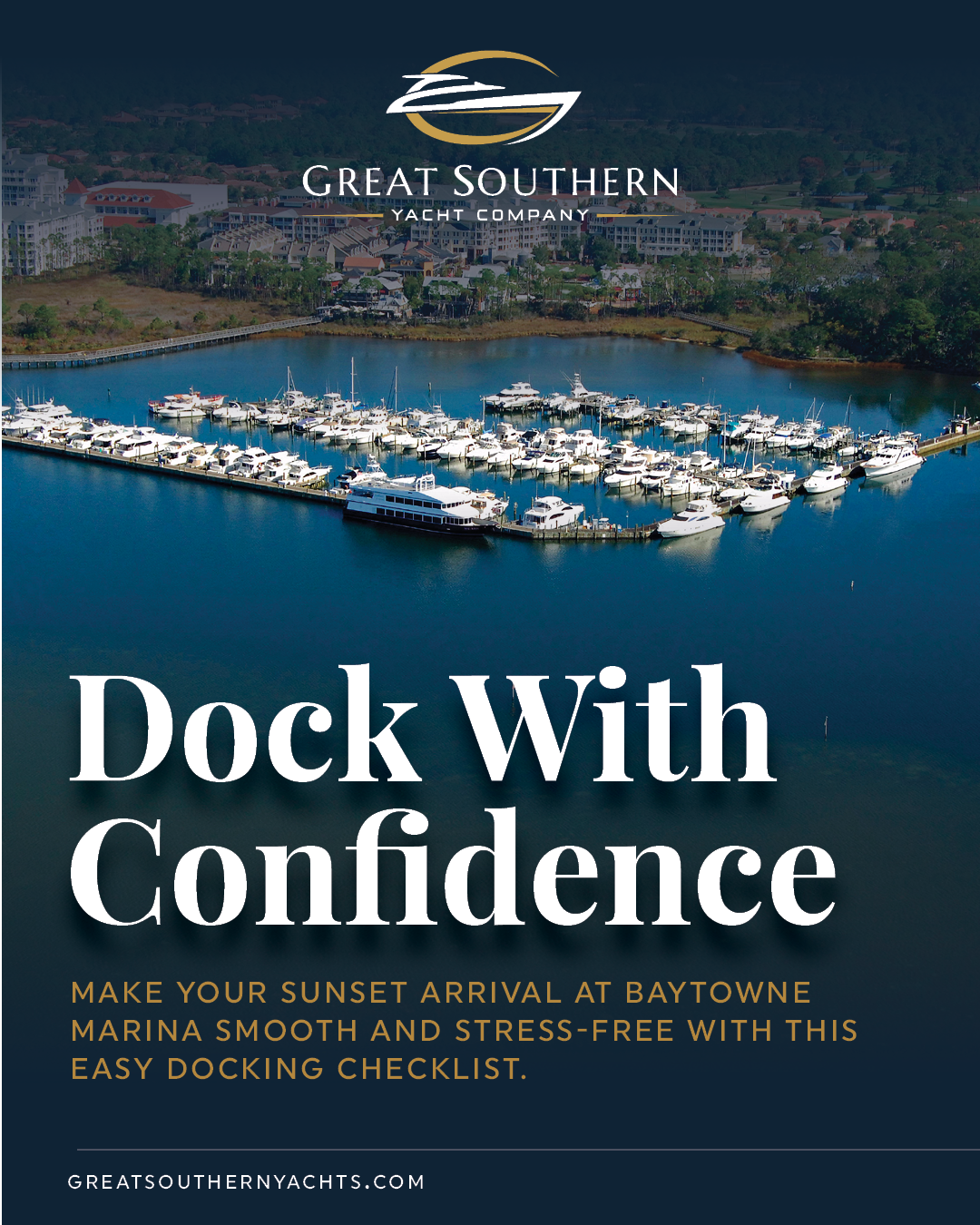
Imagine you’re docking at sunset in Baytowne Marina—here’s our calm checklist for stress-free arrivals
Docking at Sunset in Baytowne Marina: A Calm Checklist for Stress‑Free Arrivals
Arriving by water into Baytowne Marina at sunset can be one of the most rewarding moments of owning a yacht along Florida’s Emerald Coast. It can also be one of the most stressful if you’re tired, the marina is busy, or the conditions are less than ideal.
As private yacht consultants and yacht brokers serving Destin, Sandestin, Miramar Beach, 30A, South Florida, and clients nationwide, we see the same patterns: a calm, repeatable process turns every arrival into something you actually look forward to.
Use this practical, no-drama checklist to make your Baytowne Marina arrivals smoother, safer, and more enjoyable.
1. Set Up Early, Long Before You Reach the Marina
Stress-free docking starts miles before you see the marina entrance.
Check conditions and timing
- Review wind, tide, and current for your ETA.
- Note sunset, civil twilight, and marina office hours.
- Confirm fuel dock and transient slip availability if needed.
Prepare your crew
- Assign clear roles: helm, lines, fenders, and lookout.
- Brief everyone on hand signals and voice commands.
- Remind guests: no jumping to the dock, no hands or feet between boat and pilings.
Ready the boat for close-quarters maneuvering
- Turn on navigation lights early.
- Close hatches and secure loose items.
- Power up thrusters, windlass, and any joystick system; verify they respond properly.
The goal: by the time you approach the harbor entrance, the only thing left to do is execute the plan—not create it.
2. Make Your First Call to Baytowne Marina
A calm arrival starts with good communication.
Before entering the harbor:
- Hail Baytowne Marina on VHF (typically Ch. 16/68 – confirm locally).
- Provide vessel name, length, and whether you have a reservation.
-
Ask for:
- Slip assignment
- Approach instructions
- Preferred side-to for docking
- Any known shoaling or marina-specific quirks
Write the slip number and docking orientation where both helm and crew can see it. This small step alone prevents half the confusion we see at marinas from Destin to South Florida.
3. Configure Your Lines and Fenders for This Slip
A generic setup isn’t enough in a marina like Baytowne, where slips and pilings vary. Adapt before you’re in tight quarters.
Ask the dockmaster:
- “Floating or fixed dock?”
- “Finger pier on port or starboard?”
- “Pilings fore and aft, or just at the outside corner?”
Then:
- Rig fenders to the correct side at the right height for the dock type.
- Pre-set bow, stern, and at least one spring line on the docking side.
- Lead lines so they can be thrown or handed off cleanly—no knots or tangles.
If you’re unsure how the slip is configured, rig both sides and adjust as you enter the fairway. It’s easier to move a fender than to repair gelcoat.
4. Plan Your Approach Like a Pilot, Not a Passenger
By the time you line up for your slip, you should have a simple game plan you can state in one sentence, for example:
“We’ll enter at idle, turn starboard into fairway B, then back into slip 34 with the finger on our port side, using port bow and stern lines first.”
Key elements to consider:
- Wind: Favor approaches that let you work into the wind when possible; it gives you better control at low speed.
- Current: Especially around tidal changes, plan for set and drift in the fairway.
- Boat handling: Joystick vs. traditional throttles, single vs. twin screw, bow and stern thrusters—build your moves around your boat’s strengths.
Say the plan out loud to your crew. It reduces uncertainty and gives everyone a mental map of what’s next.
5. Slow Everything Down: Speed, Voices, and Decisions
The quieter and slower the arrival, the safer it becomes.
At the helm:
- Use idle or just above idle for almost everything inside the marina.
- Make small, deliberate throttle and steering inputs.
- Resist the urge to “salvage” a bad angle; if it’s not lining up, reset and try again.
For the crew:
- Use calm, concise phrases: “Two feet off,” “Hold,” “Ease,” “Take a wrap.”
- Avoid yelling; it usually means something went wrong upstream in the process.
- If someone is unsure, they should speak up before the critical moment, not after.
One of the things we evaluate as yacht consultants is how manageable a vessel feels for its owner in these moments. A yacht you can dock calmly is a yacht you’ll use more often.
6. Finish Cleanly: Lines, Power, and Paperwork
Once the boat is safely in the slip at Baytowne Marina:
Secure the vessel
- Set bow, stern, and spring lines—then fine-tune tension for tide and expected weather.
- Add chafe protection where needed.
- Double-check fender placement along the dock and pilings.
Shift from “arrival mode” to “overnight mode”
- Connect shore power and verify load and polarity.
- Confirm battery chargers, air conditioning, and key systems are operating.
- Log engine hours and note any issues from the trip while they’re fresh.
Touch base with the marina
- Confirm your check-in details, Wi‑Fi, gate codes, and fuel or pump-out plans.
- Ask about local restaurant hours and quiet hours if you have guests aboard.
This final step closes the loop—your yacht is secure, systems are stable, and your night at Baytowne is set up to be as relaxing as the arrival.
7. Build Your Own Reusable “Baytowne Arrival” Checklist
The most confident owners we work with—from first-time buyers to megayacht veterans—tend to rely on written checklists. They turn stressful moments into routine procedures.
Consider building a one-page checklist that includes:
- Pre-arrival systems check
- VHF call script and marina details
- Standard Baytowne line and fender setup
- Crew assignments
- Post-docking tasks
Keep it at the helm and refine it every visit. Over time, your sunset arrivals will feel less like an event and more like a familiar, enjoyable rhythm.
If you’re considering buying or selling a yacht in Destin, Sandestin, Miramar Beach, 30A, South Florida, or anywhere along the Gulf and East Coasts, Great Southern Yacht Company is here as your private yacht consultant. Reach out to our team for clear, experience-based guidance on selecting, managing, or upgrading the yacht that fits the way you truly want to cruise.