
Yacht
Brokerage
Refined
Strategic guidance for buyers and sellers who expect more.
View All Listings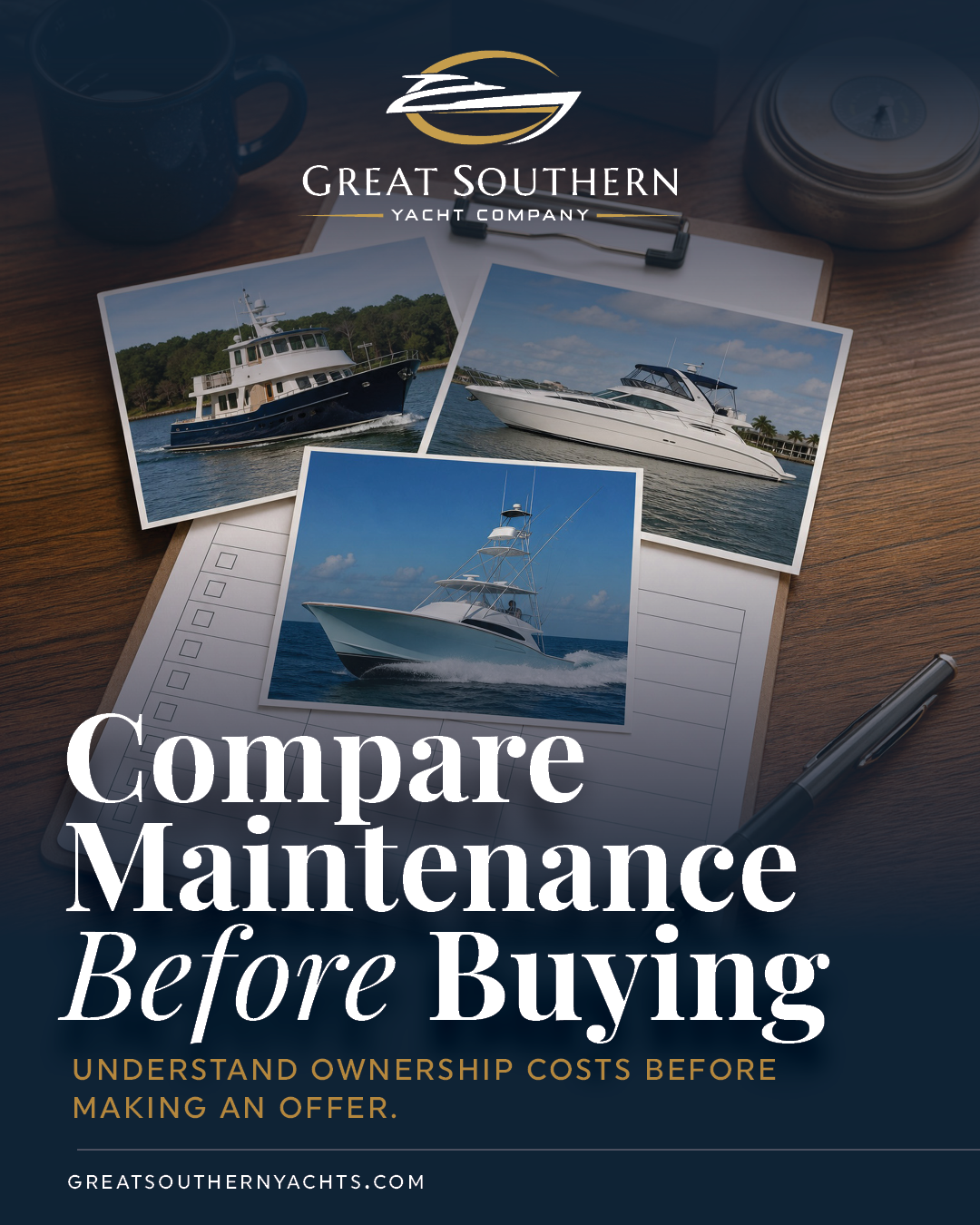
Buyer’s cost-comparison checklist for trawler vs cruiser vs sportfish: start with propulsion type, expected fuel burn at your target speeds, and how engine room access could change labor hours during routine service
Buyer’s Cost-Comparison Checklist: Trawler vs Cruiser vs Sportfish
Choosing between a trawler, express or flybridge cruiser, and sportfishing yacht is rarely just about layout and aesthetics. Over time, ownership costs often matter more than the initial purchase price. Three technical factors drive a large share of those costs:
- Propulsion type and horsepower
- Fuel burn at your realistic cruising speeds
- Engine room access and how it affects labor time for routine service
This checklist is designed to help you compare options before you buy, whether you’re working with a Destin yacht broker, exploring 30A and Miramar Beach marinas, or evaluating vessels nationwide.
1. Start With Propulsion Type, Not Just Top Speed
The propulsion package on a trawler, cruiser, or sportfish defines both your running costs and your maintenance profile.
Trawlers: Efficiency and Longevity
Most trawlers are designed around:
- Single or twin diesel engines
- Lower horsepower, high-torque powerplants
- Displacement or semi-displacement hulls
Cost implications:
- Lower fuel burn per mile at displacement speeds
- Fewer engines and systems to service (especially single-screw setups)
- Often simpler, more “commercial” machinery that favors durability
Questions to ask:
- Is it single or twin engine, and why did the previous owner choose that configuration?
- Are there stabilizers or additional systems that add service cost (e.g., fins, gyro)?
- How many hours are typical for this engine model before a major overhaul?
Cruisers: Versatility With More Complexity
Express and flybridge cruisers often prioritize speed and comfort, using:
- Twin diesel inboards
- Stern drives or pod drives (IPS, Zeus, etc.) on some models
- Planing or modified-V hulls designed to run at higher speeds
Cost implications:
- Higher fuel burn when used at “normal” cruising speeds (18–25 knots)
- More complex drive systems and steering controls
- Additional systems: generators, air conditioning, thrusters, gyros, etc.
Questions to ask:
- Are pod drives or stern drives involved, and what are the recommended service intervals?
- What are typical costs for annual pod/drive maintenance in your area?
- Has the vessel been maintained by brand-authorized technicians?
Sportfishing Vessels: Performance First
Sportfish yachts prioritize speed, range, and offshore capability, with:
- High-horsepower twin diesels
- Often higher cruise speeds (25–32+ knots)
- Heavier-duty running gear and fishing systems
Cost implications:
- Significantly higher fuel burn at cruise
- Larger-capacity systems: generators, pumps, refrigeration, livewells
- Heavier wear and tear if fished aggressively offshore
Questions to ask:
- What are the recommended load percentages and cruise RPM for these engines?
- Are there known cost milestones (e.g., 2,000- or 3,000-hour major service)?
- How does the boat perform throttled back to trawler-like speeds?
2. Compare Fuel Burn at Your Realistic Target Speed
Many buyers look at top speed and “brochure” fuel numbers. It’s more useful to start with how you will actually use the boat.
Step 1: Define Your Target Speed by Use Case
Be honest about where and how you’ll run:
- Intracoastal and local cruising (Destin, 30A, Miramar Beach): 7–12 knots is common for relaxed coastal runs.
- Offshore fishing or Bahamas runs: 20–30 knots may be more realistic for a sportfish or performance cruiser.
- Looping or long-range cruising: 7–9 knots on a trawler or efficient semi-displacement hull.
Step 2: Ask for Real-World Fuel Curves
For each boat you’re considering, have your yacht broker or surveyor help you obtain:
- Fuel burn (GPH) at 8–9 knots, 12–15 knots, and full cruise
- RPM and load percentage at those speeds
- Any notes from past sea trial reports or engine data logs
Then compare:
- Trawler at 8–9 knots vs. cruiser throttled back to 8–9 knots
- Cruiser at its common cruise (18–22 knots) vs. sportfish at 25–28 knots
- How much extra you really pay per hour and per mile for “arriving sooner”
Step 3: Convert GPH into Cost Per Nautical Mile
A simple framework:
- Multiply GPH × fuel price to get hourly fuel cost.
- Divide by your speed in knots to get cost per nautical mile.
- Multiply by your typical trip distance.
You may find:
- A trawler’s slow but steady 2–4 GPH can make a long-range plan very economical.
- A cruiser, run at semi-displacement speeds (10–12 knots), may be closer to a trawler than you expect.
- A sportfish can be reasonable when throttled back, but dramatically more expensive at 25–30 knots.
Ask your broker to walk through real examples using your local fuel prices on the Emerald Coast or in South Florida.
3. Don’t Overlook Engine Room Access and Service Time
Two boats with similar engines can have very different annual service bills simply based on how easy they are to work on.
Why Access Drives Labor Hours
Technicians charge by the hour. If accessing basic service points requires:
- Removing flooring or interior cabinetry
- Working through small hatches or contorted spaces
- Disassembling other systems to reach filters or belts
…you will pay more for the same work.
Evaluate Engine Room Access Before Buying
When inspecting a trawler, cruiser, or sportfish, physically look at:
-
Entry and headroom
- Can an adult stand up and move around?
- Are there safe handholds and non-skid surfaces?
-
Access to major service points
- Oil and fuel filters
- Impellers
- Belts and alternators
- Heat exchangers and aftercoolers
-
Clearance around engines
- Can a technician reach all sides without major disassembly?
-
Ventilation and lighting
- Adequate lighting reduces mistakes and time; ventilation affects both comfort and corrosion.
Ask the seller or listing broker:
- How long does a typical annual service take on this model?
- Are there any known “difficult” jobs on this layout?
- Which services can reasonably be owner-performed vs. always requiring a yard?
Typical Differences by Vessel Type
- Trawlers often have more generous engine spaces with better walk-around access, especially on vessels designed for long-range cruising.
- Cruisers can be tighter, particularly under salon soles or cockpit hatches, with more contortion required for routine tasks.
- Sportfishing boats vary widely: some are designed with working engine rooms in mind, others prioritize accommodations or fishability over service space.
A knowledgeable Florida yacht brokerage can often tell you which models are “good to work on” and which are notorious for long yard bills.
4. Build a Simple Long-Term Cost Picture
Once you’ve gathered propulsion, fuel, and service-access data, create a basic comparison:
For each candidate boat, estimate:
- Annual engine and generator service (parts + labor)
- Bottom work and routine yard time
- Average fuel spend based on your anticipated hours and speeds
- Insurance and dockage/marina costs (in Destin, South Florida, or your planned home port)
You don’t need perfect precision. The goal is to see how trawler vs cruiser vs sportfish ownership aligns with:
- How far and how fast you actually travel
- Your tolerance for fuel and service costs
- Your ability or desire to perform basic maintenance yourself
Talk With a Broker Who Runs the Numbers With You
A thoughtful cost-comparison up front can prevent regret later, and it’s an area where professional guidance is especially valuable.
Great Southern Yacht Company acts as a private yacht consultant and fiduciary, helping buyers nationwide compare real-world ownership costs across trawlers, cruisers, and sportfishing vessels. If you’d like a data-driven look at your options along the Emerald Coast, South Florida, or beyond, contact our team to start a clear, no-pressure discussion about the right yacht for how you actually boat.