
Yacht
Brokerage
Refined
Strategic guidance for buyers and sellers who expect more.
View All Listings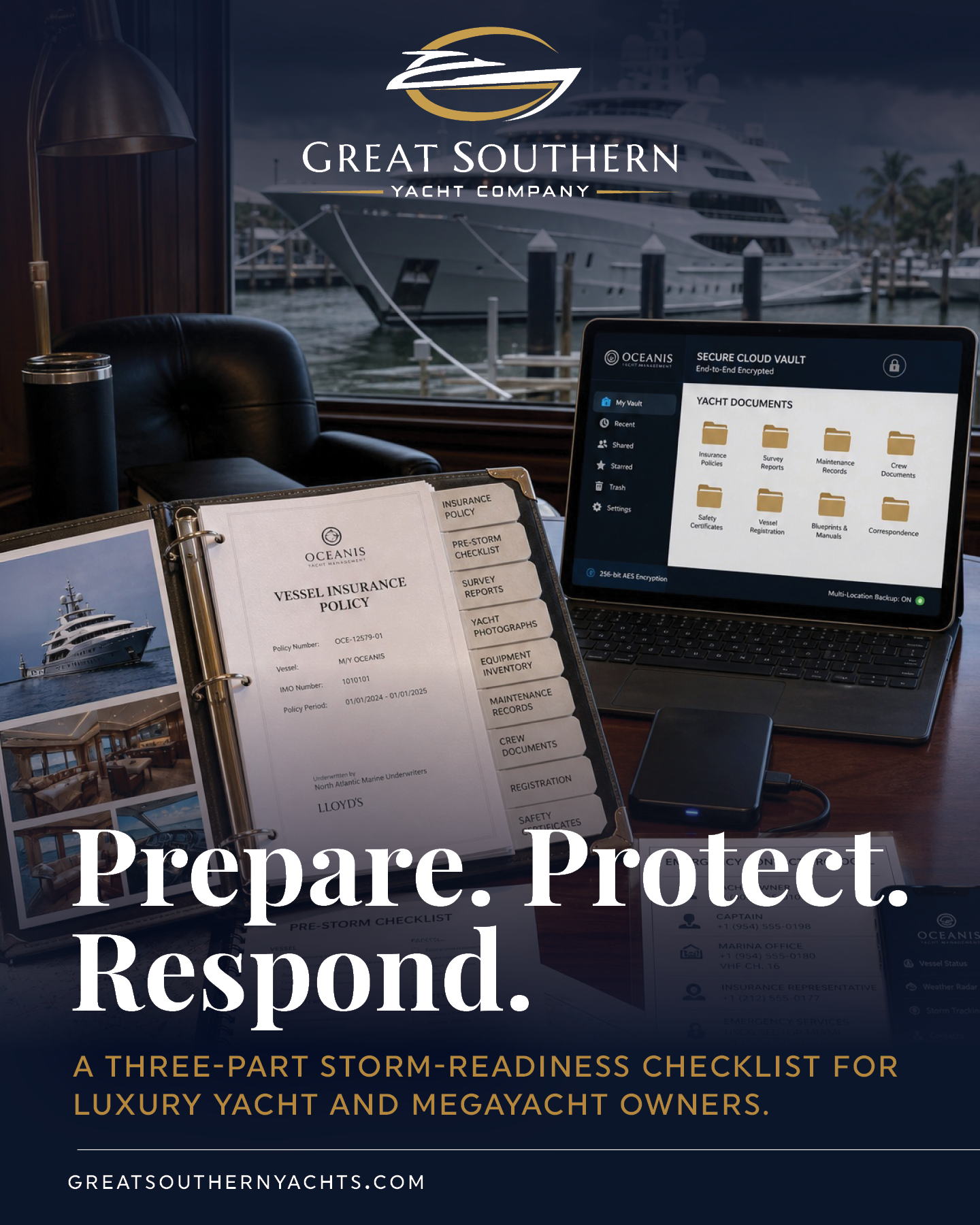
Create a 3-part checklist tailored to luxury yacht and megayacht owners that standardizes pre-storm insurance audits, secure multi-location document backups, and a multilayer emergency contact protocol shared with your fiduciary yacht co...
A 3-Part Resilience Checklist for Luxury Yacht & Megayacht Owners
Preparing a large yacht or megayacht for hurricane season or major storms goes far beyond lines, fenders, and storm shutters. For many owners, the real vulnerabilities surface after the storm: gaps in insurance coverage, missing documentation, and a lack of coordinated communication when every minute counts.
The following three-part checklist is designed to standardize your pre-storm practices in three critical areas:
- Insurance audits
- Secure, multi-location document backups
- A multilayer emergency contact protocol shared with your fiduciary yacht consultant
Whether your vessel is based along Florida’s Emerald Coast, in South Florida, or moving between marinas nationwide, this framework helps protect both your asset and your peace of mind.
Part 1: Standardized Pre-Storm Insurance Audit
A proactive insurance review before storm season can be the difference between a smooth claim and a costly dispute. Build a repeatable audit process you execute at least annually—and again when a major named storm is tracking toward your region.
1. Confirm Coverage Details in Writing
Create a short, standardized checklist for every vessel you own:
- Policy number, carrier, and effective dates
- Named insureds and any additional insureds (LLC, ownership partners, management company)
- Agreed hull value vs. actual cash value
- Navigation limits (e.g., Gulf of Mexico, Bahamas, East Coast)
- Named storm or hurricane deductibles and sub-limits
Ask your insurance agent for written confirmation on:
- How the policy responds to named storms
- Any special requirements to maintain coverage (e.g., haul-out, relocation)
- Time-sensitive reporting requirements after a loss
Document these answers in a single “Storm Insurance Summary” you update each season.
2. Understand Haul-Out, Relocation, and Safe Harbor Provisions
Many luxury yacht and megayacht policies include:
- Haul-out coverage for hauling and blocking the vessel before a storm
- Relocation coverage if the yacht must be moved out of a forecast cone
- Safe harbor requirements specifying approved marinas or distances
Standardize a pre-storm decision tree with your Destin or South Florida yacht broker and insurance agent:
-
At what forecast threshold (wind speed / cone position) will you:
- Haul the vessel?
- Relocate to an upriver or inland marina?
- Double up lines and remain in place?
- Which yards or marinas are pre-approved for haul-out or safe harbor?
- Who has authority to make the final decision if you are unreachable?
Capture this in a simple, one-page “Storm Action Plan” attached to your policy documents.
3. Align Your Coverage with Real-World Replacement Costs
Market values for late-model sportfishing boats, long-range trawlers, and larger motor yachts can shift quickly. Before storm season:
- Review recent comparable sales with your fiduciary yacht consultant
- Compare current insured value to realistic replacement cost
- Discuss with your agent whether an adjustment to agreed value is prudent
For owners operating multiple vessels or high-value megayachts, consider:
- Higher limits for tenders and toys (RIBs, PWCs, submersibles, etc.)
- Coverage for crew accommodations and alternative marina slips if displaced
- Business interruption coverage if the vessel is chartered under separate management
Part 2: Secure, Multi-Location Document Backups
In the days after a major storm, clean, accessible documentation is essential—for insurance claims, repairs, financing, and safe operation. Standardize a redundant, multi-location system so nothing depends on a single binder or hard drive.
1. Build a Master Digital Vault
Create a secure, cloud-based “Yacht Vault” for each vessel that includes:
- Title or documentation (USCG Certificate, state registration)
- Bill of sale and prior transfer documents
- Insurance policy and all endorsements
- Survey reports, haul-out records, and major refit invoices
- Engine logs, service history, and warranties
- Financing or lease documents (if applicable)
- Crew contracts, MLC/ISM documentation (for larger yachts)
Use a reputable cloud storage service with:
- Multi-factor authentication
- Role-based access (owner, captain, yacht consultant, attorney, accountant)
- Version history to track updates
2. Maintain Two Physical, Off-Boat Backups
Digital is not enough. Standardize two physical backups:
- Owner’s file – Stored in a fire-rated safe at your primary residence or office
- Advisor’s file – Stored with your yacht attorney or trusted yacht consultant
Each physical set should include critical originals or certified copies:
- Vessel documentation or registration
- Power of attorney documents relevant to the vessel
- Key insurance pages and storm coverage summary
- Recent survey(s) and key repair invoices
- Mooring or marina contracts
Review both sets annually and after any major refit, sale, or refinance.
3. Standard Naming and Indexing
Create a uniform naming convention and index so documents can be found in seconds, even under stress. For example:
- 2024-04-15_EngineService_PortMain_CAT32.pdf
- 2023-09-10_InsurancePolicy_YachtName_HullOnly.pdf
Share the index with your yacht consultant and captain, and keep a printed copy in each physical backup.
Part 3: A Multilayer Emergency Contact Protocol
In a post-storm environment, decisions often need to be made quickly: authorizing surveys, securing temporary slips, arranging salvage, or greenlighting long-distance transport. A clear, multilayer communication protocol keeps everyone aligned.
1. Define Roles and Decision Authority
Document, in writing, who does what when a storm threatens or hits:
- Owner / Principal – Final financial authority, strategic decisions
- Captain – On-the-ground operational authority, storm prep, crew safety
- Fiduciary Yacht Consultant – Coordination with marinas, surveyors, logistics, and insurers
- Attorney / Family Office / CPA – Ownership structure and liability guidance
For each role, specify:
- Decisions they can make unilaterally (up to a dollar limit)
- Decisions requiring owner approval
- Back-up decision maker if primary is unreachable
2. Create a Tiered Contact Tree
Standardize a three-tier approach that can be activated quickly:
Tier 1 – Immediate Contacts
- Owner or designated principal
- Captain
- Primary yacht consultant / broker
Tier 2 – Operational Support
- Local marina manager(s) and dockmaster(s)
- Preferred haul-out yard(s)
- Primary marine mechanic/engineer
- Transport company or captain for repositioning
Tier 3 – Professional & Family Contacts
- Insurance agent or claims line
- Maritime attorney or family office representative
- Spouse / key family members
- Vessel manager (if applicable)
For each, record:
- Primary and secondary phone numbers
- Email addresses
- Preferred communication method during a loss event
Store this contact tree in your digital vault, physical binders, and with your yacht consultant.
3. Share and Rehearse the Protocol
A plan is only useful if people know it and can execute. At the start of each season:
- Review the contact tree on a brief call with your captain and yacht consultant
- Confirm everyone’s authority limits and responsibilities
-
Run a short tabletop “what if” scenario:
- Storm landfall in Destin with 72 hours’ notice
- Marina closure in South Florida with mandatory evacuations
- Vessel damage while stored out of state
Refine the checklist based on what you learn, and update all copies immediately.
Thoughtful preparation turns storm season from a scramble into a managed process. If you’d like help building or refining a storm-readiness framework tailored to your specific yacht, cruising plans, and insurance profile, Great Southern Yacht Company is ready to act as your long-term fiduciary advisor. Contact us to discuss how we can support your yacht ownership with clarity, foresight, and hands-on expertise.