
Yacht
Brokerage
Refined
Strategic guidance for buyers and sellers who expect more.
View All Listings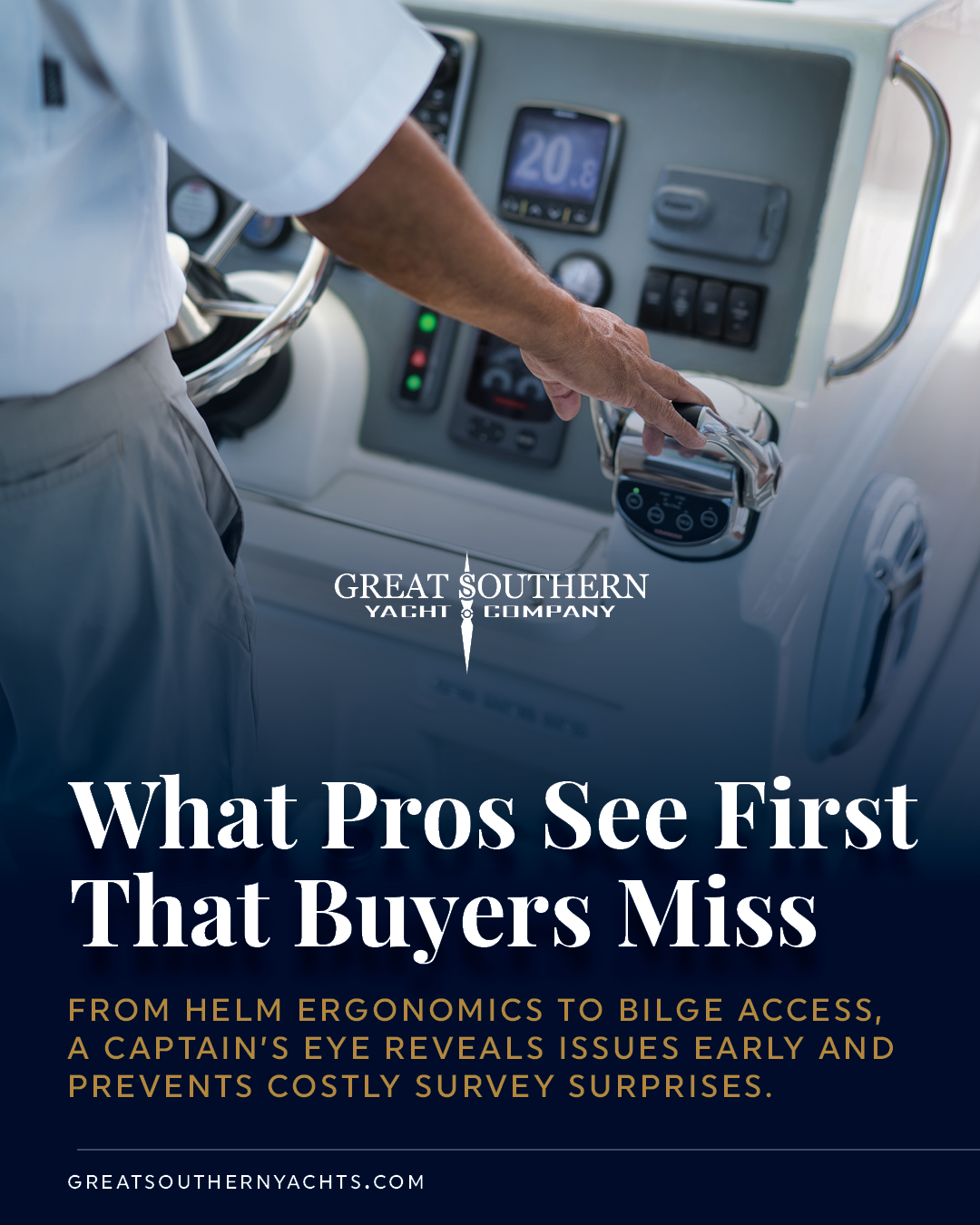
What a captain-broker looks for in a first walkthrough that most buyers miss—from helm ergonomics to bilge access—and how those details prevent survey-day surprises in Destin and South Florida; learn more on our website
What a Captain-Broker Checks on a First Walkthrough (That Most Buyers Miss)
Small details spotted early can save you from big survey-day surprises. When our captain-brokers step aboard a pre-owned yacht in Destin, along 30A, or in South Florida, we’re evaluating how the boat was used, maintained, and upgraded—through the lens of real-world operation. Here’s what we look for on a first walkthrough and why it matters before you spend money on surveyors, sea trials, and transport.
Helm Ergonomics and Visibility
The helm is where operating reality meets design. Beyond shiny electronics, we note:
- Sightlines seated and standing, forward and aft (especially crucial for tight Destin harbor docking and South Florida inlet traffic).
- Throttle/shift placement, wheel turn-to-lock, and reach to key switches and wipers.
- Seating support, footrests, and handholds for safe runs in a Gulf chop.
- MFD readability in glare, radar overlay setup, AIS integration, and autopilot access.
- Breaker labeling discipline—clean labels signal disciplined ownership.
Why it prevents surprises: Poor ergonomics and mismatched electronics lead to stressful docking and hidden upgrade costs that don’t show up on a spec sheet.
Access and Serviceability (Bilge to Bridge)
Access is value. We test whether critical systems can actually be serviced:
- Bilge access: Are limber holes clear? Can you reach bilge pumps, floats, and strainers? Is water staining historical or fresh?
- Engine room: Can a tech reach filters, seacocks, shaft seals, and belt runs without contortions? Are clamps doubled on raw-water hoses?
- Lazarette and under-sole: Clean wiring runs or a tangle of add-ons? Drip pans in place?
- Overheads and panels: Are chase runs labeled? ABYC-friendly routing or “wire spaghetti”?
Why it prevents surprises: Good access reduces labor hours for routine service. Poor access inflates annual costs and turns simple fixes into yard bills.
Deck, Ground Tackle, and Safety
We assess how the boat behaves at the dock and on the hook:
- Handholds, toe rails, non-skid wear, and boarding gate function.
- Cleats and backing plates—loose cleats crack decks and complicate transport tie-downs.
- Windlass operation, chain/rode condition, and locker drainage (a common odor source).
- Canvas, isinglass, and seal integrity in our UV-heavy South Florida climate.
Why it prevents surprises: Deck issues often escalate during survey haul-outs and sea trials. Reliable ground tackle is non-negotiable for Gulf and Keys anchoring.
Machinery Tells Without a Wrench
Before mechanics get involved, the eye test matters:
- Corrosion patterns on engines, generators, and mounts—localized or systemic?
- Hose age, softness, and date codes; signs of coolant or exhaust leaks around elbows.
- Dripless seals and stuffing boxes—salt crust is a clue.
- Generator access and sound-shield fasteners (if it’s hard to open, it’s often under-serviced).
Why it prevents surprises: Clean paint can hide problems; consistent, “boring” machinery spaces usually mean good stewardship.
Electrical and Electronics: Sanity Check
We’re looking for coherent systems, not just gadgets:
- Battery bank age, secure mounting, and ventilation; charger/inverter sizing and settings.
- Shore power (30A/50A, split/dual 50A) compatibility with your target marina.
- Bonding continuity and seacock bonding wires intact.
- NMEA 2000 and network integration—added screens without integration add complexity and cost.
Why it prevents surprises: Electrical coherence is central to reliability, insurability, and survey satisfaction.
Interiors and Living Systems
Comfort systems drive owner satisfaction:
- Air-conditioning flow (raw-water strainers, condensate drain management, pan cleanliness).
- Heads and holding: vent lines, odor, Y-valve legality, macerator function.
- Water heater, freshwater pump cycling, and evidence of leaks behind access panels.
- Joinery and hardware: uniform wear beats a patchwork of rushed fixes.
Why it prevents surprises: These are the systems you live with. They’re also common sources of last-minute renegotiations.
Paperwork and Provenance
Before offers, we quietly confirm the story:
- HIN, engine serials, model year vs. build year, and equipment lists vs. reality.
- Logbooks, service records, and engine-hour consistency across displays and ECUs.
- USCG documentation or state title status, liens, and satisfaction letters.
- Insurance and hurricane plan history—especially relevant for South Florida and the Panhandle.
Why it prevents surprises: Title defects and gaps in records can delay closings and jeopardize financing.
Local Realities: Destin and South Florida
Operating areas shape what matters:
- Destin Pass and Choctawhatchee Bay: quick-swell conditions and shallow flats make helm visibility, trim control, and draft critical. Slippage availability along 30A and Miramar Beach can influence beam and shore power choices.
- South Florida: UV, year-round usage, and saline exposure accelerate corrosion and canvas fatigue. Bridge clearances and ICW traffic make air draft and side-deck safety essential. Marina waitlists and hurricane plans impact ownership timing.
A knowledgeable Destin yacht broker or South Florida yacht broker will align vessel specs with where—and how—you plan to use the boat and secure appropriate marina and slippage options.
How This Approach Saves Time and Money
Our first-walkthrough checklist is not a survey. It’s a fiduciary screening that:
- Filters out boats likely to fail survey or blow budgets.
- Prioritizes candidates with strong serviceability and coherent systems.
- Sets a realistic pricing and refit path for “maybes.”
- Informs offer strategy and contingency language before you spend on surveyors, haul-outs, and sea trials.
For sellers, the same lens uncovers pre-listing fixes that raise confidence and compress days on market—vital in a competitive Florida yacht brokerage environment.
Private Yacht Consulting, Not Salesmanship
Great Southern Yacht Company is brand-agnostic and fiduciary-first. Our licensed brokers—including USCG Master Captains and IYBA members—travel nationwide to personally evaluate vessels, represent you at showings, manage surveys and sea trials, coordinate logistics and deliveries, and advise on marina placement. The goal is clarity: everything we know, everything we can discover, and everything our experience suggests, shared candidly so you can buy a yacht in Florida—or sell your yacht—with confidence.
Ready for a captain-led walkthrough in Destin, 30A, or South Florida? Contact Great Southern Yacht Company for private yacht consulting that removes uncertainty from your next transaction.