
Yacht
Brokerage
Refined
Strategic guidance for buyers and sellers who expect more.
View All Listings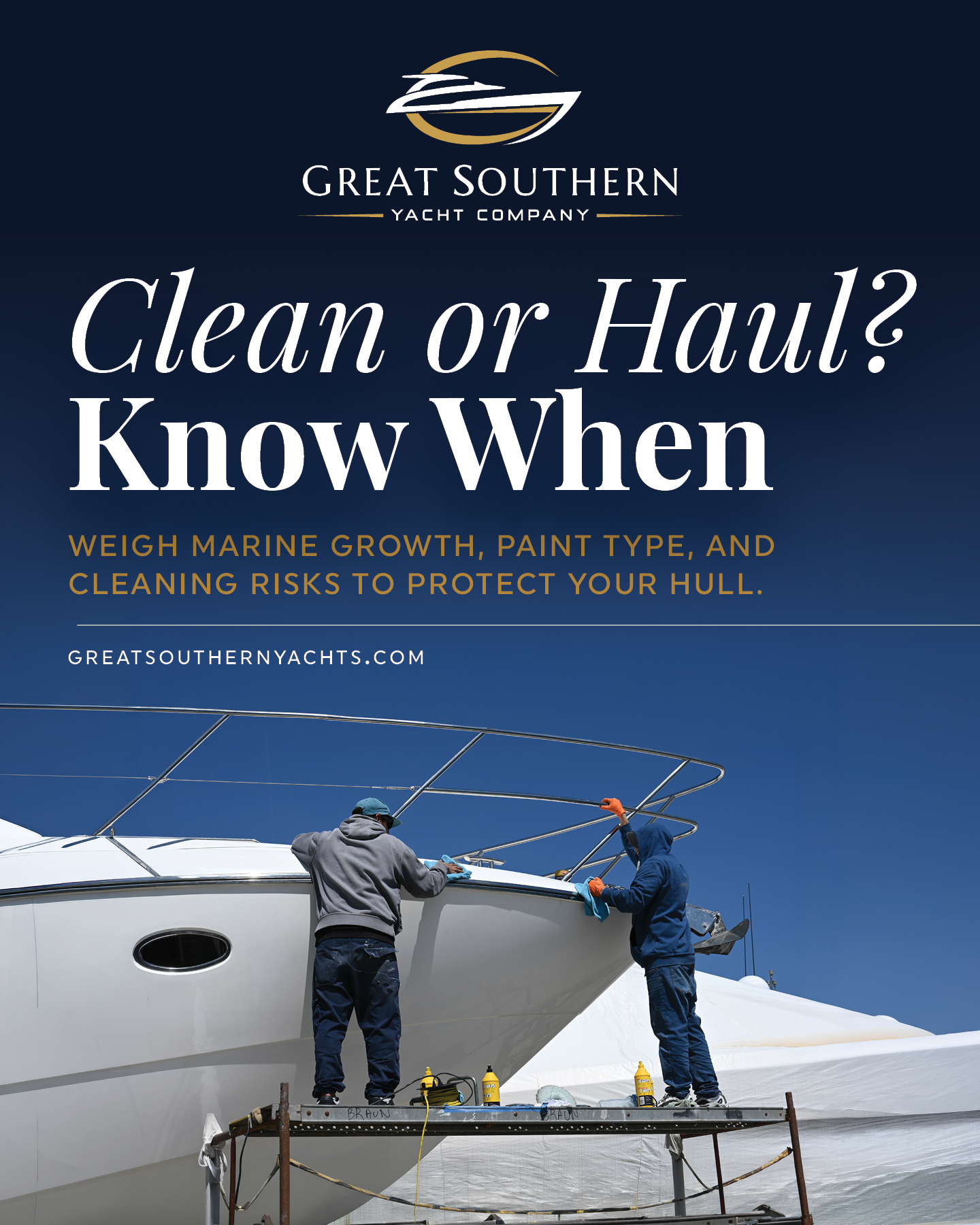
When in-water cleanings make sense and when a full haul is smarter on the Gulf: a decision flow that weighs growth type, paint choice, diver technique, and risk of coating burnish
In-Water Cleanings vs. Full Haul-Outs on the Gulf Coast: How to Decide
On the Gulf Coast, warm, nutrient-rich water means one thing for yacht owners: growth. Managing that growth efficiently is part of protecting your investment and preserving performance. The question is not if you should clean the bottom, but how—and when an in-water cleaning makes sense versus a full haul-out.
This guide walks through a practical decision flow we use as private yacht consultants along Florida’s Emerald Coast and South Florida, weighing:
- Type and severity of growth
- Bottom paint system and its age
- Diver technique and tools
- Risk of burnishing or damaging your coating
The goal: maintain speed, fuel economy, and resale value while avoiding premature repainting.
Step 1: Identify the Type and Severity of Growth
Start with what you’re actually dealing with under the waterline.
Light “slime only” growth
Typical signs:
- Thin biofilm, fuzz, or light algae
- No hard shell growth (barnacles, oysters, tubeworms)
- Vessel used regularly; paint relatively fresh
On the Gulf, this is common on yachts that move frequently and are properly painted. In most of these cases:
- In-water cleaning is usually appropriate and efficient.
- A careful diver using soft tools can remove slime with minimal impact to the coating.
Mixed soft and early hard growth
Typical signs:
- Heavier algae and grass
- Small, young barnacles or calcareous growth starting to appear
- Boat has sat longer than usual, or paint is aging
Here, it’s a judgment call:
- Localized in-water cleaning around running gear and water intakes can be smart.
- If hard growth is widespread or stubborn, the diver may need to apply more aggressive pressure, which increases the risk of burnishing or damaging the bottom paint.
Established hard growth
Typical signs:
- Mature barnacles, oysters, or thick tube worms
- Noticeable drag underway, slower speeds at the same RPM
- Multiple months of inactivity or expired bottom paint
In this scenario, especially common on yachts that have spent a quiet season in Destin, 30A, or South Florida slips:
- A full haul-out is typically the smarter option.
- Trying to “save” the bottom in-water can result in gouging, coating loss, and uneven patches that undermine both performance and long-term protection.
Step 2: Consider Your Bottom Paint System
Your paint choice should strongly influence whether you schedule a diver or a haul-out.
Ablative (self-polishing) paints
These are designed to slowly wear away, exposing fresh biocide.
- Well-suited to thoughtful in-water cleaning when the growth is light to moderate.
- Soft pads or cloths can remove slime while effectively “refreshing” the coating.
-
Over-aggressive scrubbing, especially with hard brushes or metal tools, will:
- Strip paint prematurely
- Create thin spots
- Shorten repaint intervals
If your ablative paint is already near the end of its service life, a diver’s cleaning may not buy you much time. A haul-out and repaint are more cost-effective over the next 12–24 months.
Hard epoxy or hybrid paints
Hard coatings (including some racing and performance-focused systems) behave differently:
-
They tolerate occasional gentle in-water cleanings but are more prone to:
- Burnishing (polishing the surface too smooth)
- Losing effective anti-fouling properties if aggressively scrubbed
- Divers using abrasive pads to remove stubborn barnacles can actually make a hard coating less effective over time.
If you run a fast sportfisher or performance cruiser along the Emerald Coast or in South Florida, and you rely on a hard system for speed and fuel efficiency, be particularly cautious about frequent or forceful in-water cleanings.
Step 3: Assess Diver Technique and Tools
Not all bottom cleanings are created equal. The quality and technique of the diver make a significant difference.
What a good in-water cleaning should look like
-
Soft to medium-soft tools for painted surfaces
- Soft pads, gentle bristle brushes, or cloths for the hull
- Slightly stiffer brushes only on running gear (props, shafts, struts) as needed
- Deliberate, light pressure, not “scrub until it shines”
- Awareness of your specific coating and its manufacturer guidance
If your diver is treating your hull like a dirty propeller, you may be paying to reduce the life of your bottom paint.
Red flags with in-water cleaning
Consider leaning toward a haul-out if:
- The diver reports heavy barnacle fields over large areas
- Multiple cleanings already happened this season with diminishing results
- You see visible patchiness or paint loss near the waterline or along the keel
- Your yacht’s performance has degraded significantly despite recent cleanings
In these cases, continuing to clean in-water becomes a short-term bandage on a long-term problem.
Step 4: Weigh the Risk of Burnishing and Coating Damage
Burnishing occurs when a diver or yard polishes the paint surface too aggressively, often on hard antifouling systems.
Why burnishing matters
- A burnished bottom may look smooth and fast initially.
-
Over time, it can:
- Reduce the effectiveness of anti-fouling biocides
- Lead to faster re-growth
- Require earlier stripping and repainting
On the Gulf Coast, where growth pressure is relatively high, preserving the functional integrity of your coating is often more valuable than pushing for a “perfect” cosmetic appearance between haul-outs.
When in doubt, especially with newer or premium coatings, err on the side of fewer, gentler in-water cleanings and a strategically timed full haul.
Step 5: Use a Simple Decision Flow
Bringing this together, here’s a practical decision path you can apply:
-
Growth check
- Only slime and light fuzz? → In-water cleaning is usually fine.
- Mixed growth with early barnacles? → In-water spot cleaning plus short-term planning for haul-out.
- Heavy barnacles or thick calcareous growth? → Schedule a haul-out.
-
Paint assessment
- Fresh, quality ablative paint? → Periodic gentle diver cleanings can extend performance.
- Aging or thin paint? → Don’t over-clean; plan for haul.
- Hard epoxy or performance system? → Limit aggressive diver work to avoid burnishing.
-
Condition vs. cost
- Is in-water cleaning still improving speed and economy? → Continue with a conservative schedule.
- Are results minimal, and the diver is working harder each time? → A full haul, inspection, and possible repaint will likely be more economical.
-
Operational considerations
- Long-distance trips planned (e.g., Gulf crossings, Bahamas runs)?
- Upcoming survey or sale (for buyers or sellers working with a Destin or South Florida yacht broker)?
- Insurance or safety inspections?
For any of these, a haul-out and thorough bottom assessment often provide better peace of mind and a stronger position for valuation and negotiation.
Strategic Bottom Care as Part of Yacht Ownership
Thoughtful bottom maintenance is not just a service item; it’s part of intelligent yacht ownership and stewardship. Understanding when in-water cleanings make sense — and when a full haul is smarter on the Gulf — helps you:
- Protect your paint investment
- Maintain speed and fuel efficiency
- Present a stronger vessel record when it’s time to sell or survey
If you’d like a second opinion on your bottom paint strategy, haul-out timing, or how these decisions affect long-term resale, Great Southern Yacht Company is here as your private yacht consultant.
Contact our team to discuss your yacht, your cruising plans, and the most sensible maintenance approach for Gulf Coast and South Florida waters.